Saturday, March 15, 2014

Spring is gearing up in the basement greenhouse.

It was time to get busy with my plants in the basement again.  Some of the stock plants were up to the lights and ready for cutting.  Others were pot bound and needed a bigger home for their roots. Others were ready for a good cleaning again.  A few of them needed some insect control (white flies on the Lantana again).  The bench was ready for a good shuffling around and cleaning out of all the trays.  Everything was swept up and taken out to the compost pile if it was no long attached to a plant.
The Canna rhizomes were hadn't been cleaned and potted yet and it is getting a little late in the winter if I want good sized plants to put in the garden in June.  I also put my favorite yellow begonia tuber in a pot for the umpteenth time.  I never have successfully gained more than one plant from year to year, but it is such a sunny spot in the shade.  Promises to myself to buy more each year go unfulfilled. 
I divided plants again as I had last year so my Mandevilla vine is up to four.  I have not propagated it by cuttings, just divided the original pot each year as the four cutting became bigger and stronger plants each season.  It was fun to pull them apart and see what is going on in the pot.  The roots reminded me of dividing asparagus ferns when I worked in the greenhouse with their swollen, watery root nodules.  I also divided my Pennisetum grass into four.  All the dividing and new seeding means it was time to set up more areas for plants.  Some of them are in a sunny south facing window on the second floor.  I have never set up a table here before, but it was handy and easy to set up.  The small room is cramped for space now, but it is so pleasant to sit and look at all those plants and think about spring.
I also had to add the power cord to my kitchen window light and add the boot trays for catching the water from the cuttings and seedlings.  I have my second round of coleus rooting in jars and have moved my seedlings under the light as well.  I left the micro-greens in the basement since their was still room for them yet.  It is a nice problem to have when the space is getting tight.  For me it means that spring is just around the corner.  My next round of seeding is the first weekend of April for some of the early crops and longer season varieties.  It was good to sit down and get it all in order so I can see at a glance what is coming up.  Knowing that seeding is close meant looking at my supply of clean plastic trays and inserts.  I was low on some and had to run a bucket of hot bleach water to sterilize pots today, so some inserts also went into the soaking bucket for 10 minutes of sanitation time.
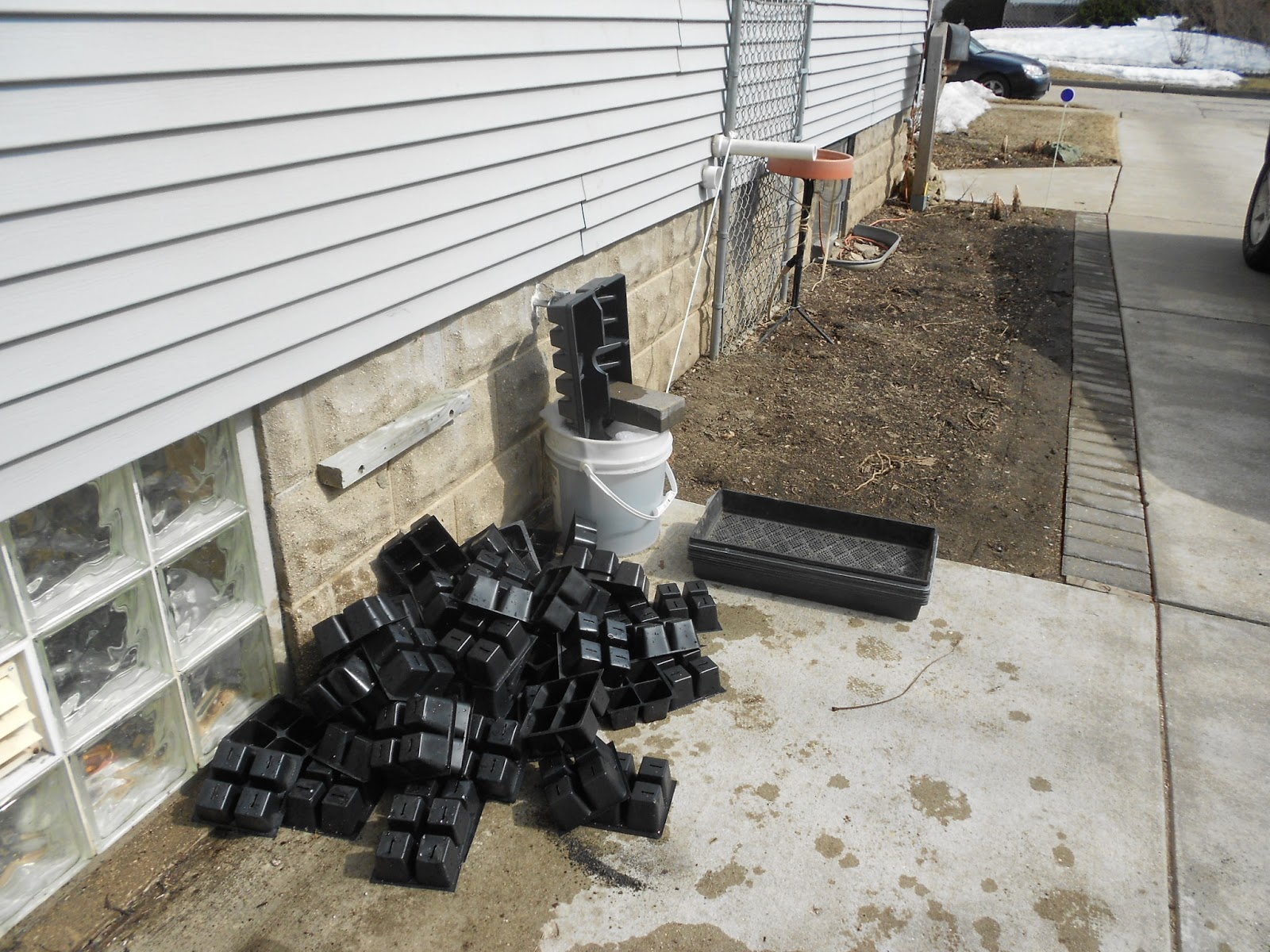
With the wedding last fall I did not clean up pots with my fall clean up last year as I did in  2012.  As a result, I have a shelf full of dirty pots, trays, and liners in my garage that I will have to deal with soon.  It is nice to not have to think about cleaning pots every time I want to do some upgrading or pricking out of seedlings.  My store shelves are empty and will have to be replenished.  Unfortunately, my garden gnomes have not been much help in this area.  I found a warm spot on the south side of the house and got busy cleaning a small batch to get me started.  The snow has melted here, but you can see in the background that there is plenty of white on the yards yet.  I am still looking at getting that cold frame put together so I can use this nice, warm patch of ground for an early crop of lettuce.  Maybe next weekend.

Friday, March 7, 2014

The Hope of Spring to Come


This was the scene just yesterday looking towards downtown Milwaukee.  The ice is thick on the water this year.  The Great Lakes are frozen over the most in over a decade.  Ice fishermen are having to use extensions on their augers to get through ice over 3 feet thick.  It is a good thing as our lake level will go up instead of down this year due to the evaporation loss being lower this winter.  The added snow will also help increase lake levels which is also a good thing.  It is just so hard being a gardener and waiting, waiting for spring to show us that it will come.
I heard the broad wing hawks out in the back yard trees calling back and forth today.  There is some snow melt and temperatures are into the 40's again.  We have a weather system moving in tonight but it is a promise of rain rather than white stuff.  It may freeze, but temperatures are going up.
I have much to do in my indoor green space.  I want to get some micro-greens going this weekend.  I have my seeding schedule all laid out, but not on my calendar to make sure I do it on time.  It is also time to make some cuttings and start pitching the old plants soon.  Spring will come, in small, quiet steps.  We turn to look and it disappears, but it is there.
I am looking forward to my annual Art in Bloom held at the Milwaukee Art Museum.  I am taking my oldest daughter for her first time this year.  I have a bonus day this year to spend with a college friend coming into town for the event.  This is such a wonderful time to take in beautiful art work, floral arrangements, and see a world class building.
Spring will come, we just have to go and find it under the snow banks this year.

Wednesday, February 26, 2014

growing microgreens

How To Grow Micro-greens
Micro-greens are very easy to grow. You can grow them outside, in a garden bed or in containers, or inside on a sunny windowsill.
If you are planting micro-greens in a garden bed, loosen the soil and rake it smooth. Scatter your seed mix so that the seeds are about 1/8 to 1/4 inch apart -- remember, we're harvesting them very young, so they don't need a lot of room. Once the seed is scattered over the area, cover it with about 1/8 of an inch of soil and water gently but thoroughly.
If you're planting in a container, the first step is to choose a container that is at least two inches deep and as large in diameter as you want. Fill it with a good quality organic potting mix, and smooth the soil. Scatter the seeds so that they are about 1/8 to 1/4 inch apart, and cover with 1/8 inch of soil. Water gently but thoroughly, an place your container in a spot where it will get at least four hours of sunlight. If you're growing them indoors, a south-facing window is best, but an eastern or western-facing one will do as well.
In either case, do not let the soil dry out, and be sure to remove any weeds so that the tiny greens don't have to compete with them for water and nutrients. Because you'll be harvesting the greens so young, you don't really need to fertilize them while they're growing. If you've got plenty of organic matter in your garden bed, that will be perfect. For containers, mixing in a bit of granular organic fertilizer to the soil before you plant will work fine, especially if you plan on using the same soil for several plantings of greens (more on this below.) Micro-greens grow for such a short period of time that they are rarely bothered by pests and diseases. However, if you are growing brassicas in your mix (mustard, kale, etc.) and cabbage worms are a problem, you may want to cover your micro-greens with a floating row cover to protect them.
Harvesting Micro-greens
The best time to harvest micro-greens is when they've developed their first set of true leaves (the first ones are seed leaves, and don't look anything like the actual leaves of the plant), which is generally about ten days to two weeks after planting. To harvest, simply snip the micro-greens just above soil level.
Unlike mesclun or baby greens, you won't be able to get additional harvests from one planting of micro-greens. Because the plants haven't had much time to develop, and you're snipping off everything except the very bottom of the stem, the plant has no way to generate new growth. You can plant another crop after harvest by simply scattering fresh seed and covering it with soil. You don't need to remove the old roots; they are good sources of organic matter.

As you can see, micro-greens are simple to grow, and provide you with a quick harvest for not much work. You can add them to salads, sandwiches, or stir-fries, and it's much cheaper to grow your own than it is to purchase them. Experiment with different mixes, adding the varieties you like best. They're definitely deserving of a spot in your garden.
INFORMATION FROM PINETREE GARDENS WITH SEED ORDER

Wednesday, February 19, 2014

Time to start your onion seeds

I got my onion seeds in seeded and on the light table yesterday.  I am not optimistic on snow melt this year so I waited an extra week or two later than normal.  Ailsa Craig was my onion of choice this year.  Keeping better records of seeding and germination times this year with the help of an Excel table.  I will let you know how well I do that.

Thursday, February 13, 2014


If you haven't ordered your seeds yet...it is time!  Don't let something new and interesting not be in your garden because it is out of stock.

Once you get them, sit down and plan out your garden and seeding schedule.  Once the warm weather arrives, you will be happy you did.

Besides, what else are you doing on a cold but sunny winter's day that can't wait while you soak it up by a sunny window?

Sunday, February 9, 2014

Time to start seeds, spring is coming...I just know it!

I officially have all my seed orders in hand with the exception of the items that get shipped later (after the ground is no longer covered with two feet of snow.

Rather than re-write the whole process, I will just share my link to the prior post on seed starting.  

Gardeners have hope.  We look at tiny seeds the size of a period and see new life.  It is amazing to know that in that capsule that looks like a comma, there are tomatoes that will grace our table at the end of summer.

I have a word of caution to those starting seeds indoors by themselves.  Please remember the essentials for success:


  • Sanitation-Make sure everything you have is sterile (pots, soil, table...) and use only new soil starter.  It does not pay to cheap out and deal with consequences of insects and disease problems.
  • Warmth-seeds need warmth to start in 99% of our garden crops unless it is something you are direct seeding later, even then it needs some warmth.  Germination percentages will be greatly affected if you choose to compromise on their needs here.  It also can affect the success of seedlings.  Damping off can take everything if you don't keep the seedlings warm as well.  Germination mats and domed covers will help you control the temperatures in ways that costs so little for your gain.
  • Water-Moisture is essential in the correct amounts.  Too little, and your germination suffers.  Too much, and your germination suffers.  You should find the happy medium where you are not blowing dust off the top of your trays and you can hardly lift your trays because of the water content.  It is best if you check them at least once a day.  Domed lids will help you regulate this as far as water loss is concerned.
  • Light-Plants can't live without it.  Even seeds that germinate best with dark conditions need light once they break that seed coat.  Keeping seedlings within 6" of their light source is best.  A sunny south window is still not enough light in the northern climates at this time of year.  Always use some sort of supplemental light, even a florescent shop light will do.
Look at your seed packets and try to time out your crops to their optimal starting time.  I error on the side of caution and time them for the shorter time (later rather than sooner) so I am not dealing with larger plants indoors because it is too cold to move them out. Plan your seeding ahead of time and then you will be able to move through the season with less worries about forgetting something or not timing your crops as needed.  

Happy Spring...I know it's coming!

Tuesday, February 4, 2014

Mid-Winter's Dream

It is winter.  It has been a long winter.  Not in terms of days, but in terms of snow.  It's not a lot of snow, I've seen more.  It is a continuous snow.  It keeps falling in one inch, two inch sometimes more.  It takes a long time to fall.  The sun comes out briefly, then the clouds come back and the snow comes again.  It doesn't seem that winter will ever end.  
I have my plants huddled in the basement, waiting.  They grow towards light that only comes because electricity makes it so.  They are warm because the furnace blows warm air into their confined space.  They are patiently waiting for the longer days of summer when they can put down roots and reach towards the sun.  I am not that patient.
On the sunny days I enjoy the warmth that comes through my truck window.  I have to get out, and it is cold.  Not 20's or 30's cold.  Below zero cold.  Day after day.  The sunny days make it all tolerable.  The furnace makes it livable.  The alcohol makes it bearable.  This is Wisconsin.
I thank God for the birds.  I feed them and they come. Cardinals, chickadees, woodpeckers, nuthatches, and of course, sparrows and finches.  They add life to the white landscape that is my yard.  The cardinals have been coming in flocks.  I notice this the last two weekends.  Up to six pairs at a time.  February will start the songs of mating.  So far they are quiet.  They come and eat the sunflower seeds, taking turns at the feeder.  They do not sing.  They eat.  When I hear the males break out their songs of spring, I know that we are headed towards spring.  Until then...we eat.