Tuesday, May 22, 2012

Picture Perfect

Yellow flags blooming on left Golden Standard hosta in front right
I've talked about my rain garden before, but this weekend I weeded, planted, and mulched with cocoa bean hulls so it is picture perfect right now.  The blooms are at their peak or just past so it has been a stunning show. With our early warmth followed by cooler temperatures bloom time was lengthened on just about everything this year.  
Blue flag in center, very small Japanese maple on right
I added a Japanese maple to add some future height in the back ground.  We also added some new river stone to the downspout  areas to refresh the old ones which also adds a bit more water break for the rushing rains we tend to get.  I also found a couple of perennials to fill here and there.  
Dwarf Alberta spruce near center with Amsonia in upper left
I was able to put in some of my annuals over the weekend, petunias for one, but will hold off on the coleus and impatiens until the traditional Memorial Day weekend planting.  My dwarf Alberta spruce enjoyed the mild winter.  I did not leave it up to nature to water with so little snow.  I put the hose out twice during the mild temperatures of February and March to get moisture around the roots.  I also piled snow around it to add some winter protection each time we got a fleeting amount.  It came through beautifully with no winter burn.  After three years in the ground, it seems to be taking off this year.
I used some salvaged netting from a tree shipment to train the sweet Autumn clematis away from the hand rail this year.  I love the way individual leaves have poked through and expanded on the opposite side making the netting a bit more organic looking.
Lined area of rain garden, ferns, reeds, native irises, and trollius fill the bottom
The ferns have found their roots this year and are rooting in other areas.  The sensitive fern has completely left its original spot and is coming in through the field stone lining the rain garden.  The hostas were happy to lose the competition the Aruncus was providing as I moved it to the "dry berm".  I did not have much luck growing coleus in this spot without having to water frequently.  The Aruncus seems to be thriving in this spot quite well.  
A perennial garden can be planned, but there is always room for improvement.  Things die and there is always something that catches my eye and I really have to have it.  I always add a few annuals into the perennial beds to give it continuous color throughout the summer.  The few woody plants that I have in this area provide anchors for the vegetative plants that dominate the spot during summer, but add nothing during the dormant months.  Size does matter, so I always keep in mind what the potential size is for a plant.  I'd rather leave room for annuals while the perennials are getting established and reduce those each year as the permanent planting get larger.  
Weeding is a must.  I have seeds from maples, box elders, buck thorn and a whole host of annual weeds that blow in.  A perennial garden is never care free.  Even with edging, grass finds its way in with self sowing seed heads.  Mulch helps keep the amount down but it is not fool-proof.  I will not use weed barrier cloths especially in an area that I will be moving and digging on an annual basis.  The cloth will not allow the mulch to decompose and become part of the soil around the plants.  Years ago, my husband and I removed some over-grown shrubs around the school property.  The mulch added year after year was decomposing on top the cloth while the gray clay soils underneath remained unchanged.  Weeds managed to grow on top the cloth and we had to pull and rip it out of the shrub roots.  A tree of heaven had grown on top the cloth and pushed roots down through the cloth making it very interesting to remove.  Nix the weed barrier cloth in the planting beds, use it around your tomato plants instead (to reduce soil splash and related fungal problems).  It is also good under rock paths and the like.
Get out the camera on those days when you are all done doing the hard work so you have lasting memories of how good it looks when you put the time in.  I really enjoy looking back at the garden throughout the season and from year to year.  With digital, even an amateur can do some amazing picture taking.
blue flag iris

Sunday, May 13, 2012

Mother's Day Tribute to my Mother (and Happy Birthday, Mom)

Door County cherry pick, Mom and Gwen
Mom knew how to eat local.  This is from a Door County cherry picking trip.  It wasn't exactly local eating from where we had to drive to pick the cherries, but it was a day trip which meant lots of pitting and canning the following day.  Going out to pick berries from the surrounding area was local and it happened every year, in each season of ripeness.  There was also the gardens that we grew as well as trips to the "muck farm" for massive amount of fresh produce for home preservation.  Canning is a skill I learned through observation and repetition.  
Mom with her camp cookware
Cooking outdoors was also a skill I learned from my mom.  In my 6th grade year she gave my dad an ultimatum.  Less time in the bar, more time with her.  They bought a camper.  Mom was quite an outdoors cook.  I think it stemmed from growing up with wood stoves on the farm.
Mom and Dad at Boulder Lake September or October 1970's
Those camping trips with my parents were special times.  Half of my sisters were grown and out of the house by the time the camper came into being, but that didn't stop them from becoming family trips.  These photos are from sister #3 and the car in the background belonged to sister #2 and her husband.  (I am #6 in a line of seven girls.)  We would take week long trips in the summer.  Sometimes it was a long weekend trip to go hunting or fishing.  It was always good to get away from the TV and spend some time talking around a campfire.
Mother's Day camping trip late 1970's
Mother's Day weekend became our first official camping weekend of the season.  Our most memorable trip was to northern Wisconsin (more north than we already lived).  The temperatures were in the high 70's when we left on Friday.  They never were that warm again the rest of the weekend.  The kids wore socks on their hands to warm up as we didn't bring winter gloves.  We also warmed rocks by the fire to warm our hands.  There's a whole story there which ends up with stitches in the emergency room...another time for that one.
Picnic 1970's Mom and Dad
We went on picnics frequently as a family.  We didn't stop and eat in restaurants.  The large number of people in our family made that cost prohibitive.  We would pack a lunch and eat it in some nice spots somewhere along our route.  Dad and Mom liked to take Sunday drives through the woods that surrounded our area in the Nicolet National Forest.  Dad never owned a 4-wheel drive vehicle in his life, but that didn't stop him from taking us boldly where only logging trucks have gone before.  Dad gave us an adventure every time.
Lunch during tree planting 1970's
We also learned a work ethic from our parents.  No one was too young to contribute in some way.  In order to earn tuition money for my older sisters to go to a different district's high school (this was also a lesson in political activism), we went in groups to plant trees for the Forest Service.  Grown ups would make the hole with the planting bar while we little ones put the trees in for them.  Looking back, it was the little ones that carried the bag of trees and did all the bending.  I'm sure some would consider that child abuse, but we lived through it with mostly fond memories.
Mom in front of the old Red Owl store
Even after dad passed at an early age, Mom continued to teach us how to make it in this world.  She went back to work to earn some extra money beyond Dad's pension.  She also passed on her great sense of humor to all of us.  Dad was the prankster in the family, Mom had a finely tuned wit.  Laughter is a gift that should never be over looked when considering the legacy you leave your children.  We have a rich legacy from our parents in that department.
Gwen and Mom 1960's
I also learned early on how to enjoy a cold beer after a hard day.  Before any one out there gets the wrong idea, my parents did not get us drunk to sit and laugh at us.  It involved a sip or two to see our reaction to such a different taste.  No children were harmed in the taking of this picture.  Enjoying the little things in life is really the best take-away my parents could give me.  I still can be happy with the small stuff in life.  It's all the small stuff that makes a big impression.


Wednesday, May 9, 2012

On the "to do" list today

1.  Clean all the debris out of the "pond", change water, and get the pump running.
2.  Flood the pressure washer trying to start it so you can clean out the "pond".
3.  Weed all the maple seedlings out of front beds while you wait to try starting the power washer again.
4.  Successfully start the power washer and clean all the Lannon and field stone in the wall around the "pond", the "pond" liner, the wooden park bench, and the bird baths.
5.  Find the Teflon tape so you can join the two hoses with no drips.  Use it and be happy there are no drips.
6.  Now that the pond is done, look over and notice that the herb garden needs attention.
7.  Re-pot  the catnip, peppermint, and sage into larger pots and sink them back into the herb garden.
8.  Move the rhubarb into the herb garden from behind the garage in case John really does build a bigger garage next year.
9.  Water in everything you moved, potted, and neglected this morning with water from the rain barrel which is overflowing after 3" of rain this weekend.
10.  Realize your back is killing you from bending over so much, go in the house for a beer, and sit at the table to enjoy the backyard.


Saturday, May 5, 2012

Eviction Notice

The larger, hardy plants have gotten their eviction notice.  Such a cruel thing to do on a cool, rainy morning.  But, it had to be done.  My jasmine, scented geranium trees, mandevilla vine and rosemary all got moved to the north side of the garage to start the acclimation process.  They are just steps away from the service door, so should cold weather strike, I move them in there to take cover.
I moved a few of the potted items outdoors as well this morning.  My ivy geraniums and citronella geraniums were put into larger pots and put on the rolling rack.  The alpine strawberry boxes are added weight to the shelves for now, but will find a home hanging on the fence or someplace else soon.  I added casters to this shelf last fall.  Now I will be able to roll it into the garage on cold nights instead of moving the flats in one by one to the floor of the garage.  Next week will result in more evictions as I need the space indoors.
The reason for the evictions was two fold.  First, the larger plants need to acclimate.  Second, I ran out of room and transplanting had to be done.  My tomatoes have a good set of second leaves with strong centers.  I upgraded my Black-eyed Susan vines (Thunbergia). I flatted up the rooted coleus.  Also completed transplanting of tomatoes, agastache, some petunias, and parsley.  I came up with a solution for getting the new transplants within 6" of the lights.  I turned over 4, 4" pots at the corners of the flats to give them a boost up towards the lights.
I had great germination of the Thunbergia which are starting to vine.  For Christmas, my sister gave each of us a Topsy-Turvy strawberry planter.  I was not going to use it for strawberries so that became my transplanting vessel for some of the vines.  The variety I bought this year is Spanish Eyes, which is slightly lighter than the traditional Black-eyed Susan vines I have had, which I grew from saved seed with a 25% germination rate.  Some of these will go along the fence to vine in with the sweet peas, which will fade during the warm weather.  I also had some with the Sweet Autumn clematis last year.  The yellow and white combination was beautiful last fall.  
I have to balance the check book now so I can get over to the garden center today for more potting soil.  I am sticking with a light-weight mix which has served me well for indoor use.  I will also get some for the pots which will be coming together soon.  This winter I purchased an organic blend which was intended for indoor use.  I was skeptical of the heavier weight it had and it seemed to have "something" weird about it.  White flies showed up soon after (which I never had in my house before).  Another minus of this blend was that all the seed I started with this as my base layer had extremely poor germination.  Hard lessons are learned when I try to move forward against my better judgement.  Maybe I will listen to myself next time.  I really need to get a move on as time is running short in the day.  The garden center will not be a quick trip as I will want to browse.  Enjoy your own weekend.  Now that spring is really here, take time to stop and smell the flowers.
Jasmine

Sunday, April 29, 2012

Arbor Day in review

We celebrated Arbor Day on Friday.  The fourth Friday in April has been set aside to celebrate the importance of trees.  There were celebrations in each district in Milwaukee, some earlier this week, many on Arbor Day.  Some were big with the Mayor and other dignitaries present.  Some were small with parents and children watching, for the first time, a tree planted for their future enjoyment.
I had the pleasure of attending five of those celebrations with different schools and libraries on our side of town.  The teachers and kids do a great job of putting together their own special programs.  There is singing at some, poetry at others, and proclamations read from the mayor designating this day as Arbor Day.
Our Forestry Department employees put in a lot of hard work to get the trees in the ground ahead of the celebrations.  Some of the kids were able to watch as the trees went in the ground from their school windows. The kids do a ceremonial planting by mulching and watering the trees which have been planted for them.  
Even though the things they do are more ceremony than function, they learn about the trees and their importance in our environment.  They know that the air they breathe is because the trees turn the carbon dioxide around them into oxygen for them.  They appreciate the shade and learn to climb the trees that have been planted years before they were born.  They will enjoy the colorful leaves in autumn as they play on their school grounds.
After all the ceremonies, the kids are given a spruce tree to take home and  plant themselves.  It is great to see the smiles and laughter. The kids enjoyed on a sunny day made perfect for Arbor Day.

Saturday, April 28, 2012

Reused-repurposed-recycled

If you have read more than one of my blog entries, you are aware that I use whatever works.  I have somethings in my gardening gear that I bought new and paid a dear price for it.  Those tools have been worth the extra money I have spent.  I still have the same two trowels I bought 25 years ago, and they are not showing any signs of giving out.  Other times I use found items to work for my gardening needs. Plastic sheeting from old greenhouses is still good enough for drop cloths and tarps.  Containers are tops on my list.  Do not be too proud to stop and pick through someone else's discards.  People put good containers at the curb because they changed their color scheme.  Other items found at the curb that weren't made for plants can also be used for potting up.  Just make sure there is drainage out the bottom, make a hole yourself if you have to.
Rummage sales are the next best place to add to the garden treasures.  My tomato cages were twenty-five cents a piece and still going strong two decades in. Plant stakes can be fashioned out of all kinds of things.  I have bamboo salvaged from a garbage heap.  The orange snow fence was found in a ditch from an old construction site.  This year it is a pea trellis.  Our city forestry department has wood chips for the scooping at their self-help disposal site.  Other communities near-by compost their leaf collections and put them out on a first come, first served basis.
Our gravel base has moved twice in our yard.  It was put down by the previous owner around the pool.  The pool came out and the gravel and sand went into different piles.  The lumber from the deck has been used three different ways already.  The latest project is a wood rack for the fire pit we recently updated for our backyard.  The wood to 
fill it has come from downed trees and branches removed from our own yard.  (The wood still has to be moved from the old location.  Might get the teenager to do that.)
There is still a stack in the garage with various projects in mind.
The previous owners also invested a bunch of money into tons of Lannon stone, a local commodity.  We have dug it out of collapsed hills and walls to rebuild the terraces in the yard.  My husband put in block steps which were from a display at the local stone company, purchased at a fraction of the original price.  Materials are every where if you just look.
With a little thought and creativity, you can do some fun things with the right materials.  Do some reading and learn how to do it right so you don't have to do it again. My neighbor told me how a landscape company put in the original Lannon stone walls.  They didn't do it right which is why they were buried under eroded slopes instead of holding them back.
Be on the look out for things at the curbs and alleys at this time of year. People are cleaning out their garages and yards, so the materials will be out there for the taking.  Even if you get just one season out of an old chair, it just might make a great plant stand for that urn you found over on 14th Street.  Bed rails can be a bean trellis.  Garden gates could hold up your cucumber vines.  Use discretion.  You don't want to become Fred Sanford.  

Wednesday, April 25, 2012

In the end...were all compost

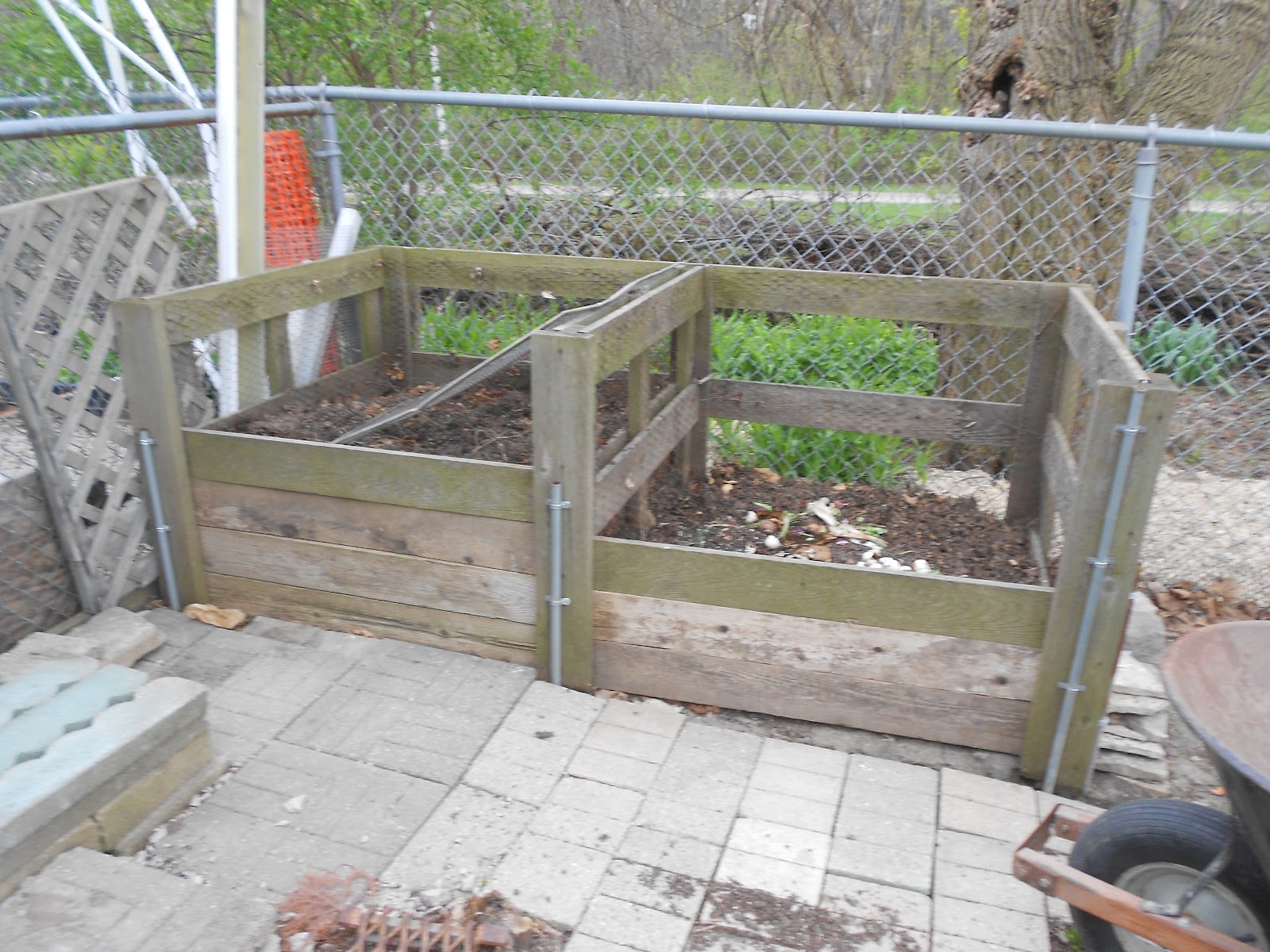
my compost bins
I have a compost bin, well two compost bins.  They are tucked into that same corner behind the garage as my very lovely, blue rain barrels.  My husband is not fond of their appearance, either, but is fine with their presence in our yard.  He built them for me by just a description of how I would like them to be.  I can change the front boards from side to side by just sliding them up from one and down into the other.  He is a genius when it comes to making things work for me.  In return, he gets to dump the yard clippings in from the grass cutting.  I don't do grass if I don't have to.


Compost tools
My compost tools are simple.  I have a good sized wheelbarrow, a garden fork and a screen with 1/2" size or so openings (they are actually rectangles which are about 1" long).  Size doesn't really matter unless you want your composted screened fine enough to put through a lawn spreader for your turf areas.  The screen should be framed out to hold it stiff over whatever you are sifting it into.  They even sell screens that fit over 5 gallon pails so you can tote the compost wherever you need it.  Making them is cheap enough.  Once again if you don't have the tools, you can always bake the cookies. (See roll out the rain barrels if you don't get what I'm saying.)
sifting the compost
The process is quite simple for sifting out the compost.  From the side that is mostly ready, scoop out a heaping helping onto the screen.  Gently move it back and forth with the garden fork to sift out the good stuff into the wheelbarrow.  The larger leaves, food bits, and a few worms will stay at the top.  


red wigglers

Do be gentle as you want to save the worms to either head to your garden bed or go into the unfinished bin to help you make compost.  Dividing worms does not make more worms even if they are broken where they can heal.  Only one part will live so...be good to your worms.  I have a few larger crawlers in my pile but the bulk of my worm population is red wigglers.  You can buy worms but I found mine and added them to the heap years ago where they have been forming a happy community since they were introduced.


unfinished bits
Once you have all the finer, composted bits  sifted out, dump the unscreened materials into your unfinished compost.  If you only have one compost bin, just set it off to the side to put back into the bin when you are done.  A small tarp or piece of plastic will work as then you can just pick it up to dump it in when you are finished.  
Keep repeating the process until you empty your bin or you have as much compost as you need for the day's work.  The beauty of two bins is that I can do a little compost each time I need it.  My husband will add clippings into my unfinished side and I dump our kitchen scraps bucket in there as it fills.  The bucket we use is just a repurposed plastic pail with no cover.  We dump coffee and filters right in along with egg shells, vegetable and fruit scraps and all other kinds of rotten stuff.  Avoid meat and fat as it may attract rats which neighbor's will frown upon as well as the city.  (Yes, there is an ordinance against this in our fair city.)  But I digress...


finished compost
With a little bit of work, you soon have a whole wheelbarrow full of lovely, nutritious dirt and worms for your garden beds.  I am not a very dedicated fertilizer applicator.  Compost is my main fertilizer in my gardens.  They really don't need a whole lot more.  A soil test could prove me wrong, but who wants to pay to be told they're wrong.  Actually, I have normal plant growth and coloring so I don't see the need.  Now if I was trying to grow blueberries in our alkaline soils, I might be more inclined to analyze this deeper.  I am not dedicated enough to home grown blueberries for that...yet.
There are all kinds of "recipes" for the best compost.  I don't buy anything to try and make sure my bin has the right balance of brown and green.  The green comes in summer, the brown with autumn leaves and plant material.  I will add in the pea vines as they wither in the summer heat and the compost pail is emptied in at least once or twice a week. I will dump my pots into it in the fall as well as any plant clippings I take off during my greenhouse operations.  
I do mix it up very occasionally to oxygenate the pile, but I am not dedicated enough to be a religious compost pile turner.  If the weather is dry, I will add some water from the nearby rain barrels to keep the worms happy and digesting my potato peels.  Avoid too wet as worms will not like that either.  My bin has very little wood on the sides.  It is lined with 1" chicken wire to keep the stuff in, consequently it doesn't hold a lot of moisture.  I have covered it with plastic sheeting during extremely wet weather to keep it from getting totally soaked.  Purchased bins often come with a cover.  It is quick and easy but not cheap.  I priced one out several years ago at over $100.  That was not in the budget.
With a little bit of work and waste, you can start your own compost pile.  The benefits of having really good soil are worth it.