Showing posts with label misting. Show all posts

Monday, April 23, 2012

So, what's up?

I kept myself pretty busy with gardening this week.  So much is happening inside and outside the house now.  I will do a quick run-down on the seeds I have gotten in and what has sprouted so far.


Seeding


On 4/9 I seeded agastache, hollyhocks, petunias, impatiens, thunbergia, radicchio, and lettuce.  The hollyhock were up on 4/12, petunias on 4/14, radicchio 4/12, and thunbergia on 4/18.  The impatiens have also started sprouting but very spotty.  That does not make me happy.
On 4/7 I seeded some of the garden seeds. Flowering sweet peas and garden peas were both soaked 24 hours and then into the ground.  The garden peas are up as of 4/18, nothing with the flowering sweet peas yet.  I seeded more outdoors on 4/12, green onions, beets, Swiss chard, radishes.  The radishes were up by 4/18.
On 4/15 I seeded tomatoes, peppers, marigolds, asters, zinnia and nasturtiums. Tomatoes, marigolds, asters and zinnias were all up on 4/18.  
I have one more round of seeding this next week for indoor plants.  I will get the soybeans in the ground this next week along with some of the direct seeding of flowers.  I put the first round of cilantro seeds in the ground over the weekend.  Let's see if I remember to get a few seeds in every couple weeks this year.


Transplanting


This weekend I was able to transplant the earliest seeding from mid-March.  I started them before going on vacation and they had less than ideal germination without someone checking on them twice a day.  I do not hold this against my eldest as she did bring some of them through for me.  The viola germinated the best, and I was able to transplant 36 good seedlings.  Heliotrope came through with 6 plants.  We won't talk about the mammoth stock which are not living up to their name.  I also moved my coleus into larger pots so they can put on a little more growth before May garden time.
Transplanting viola seedlings

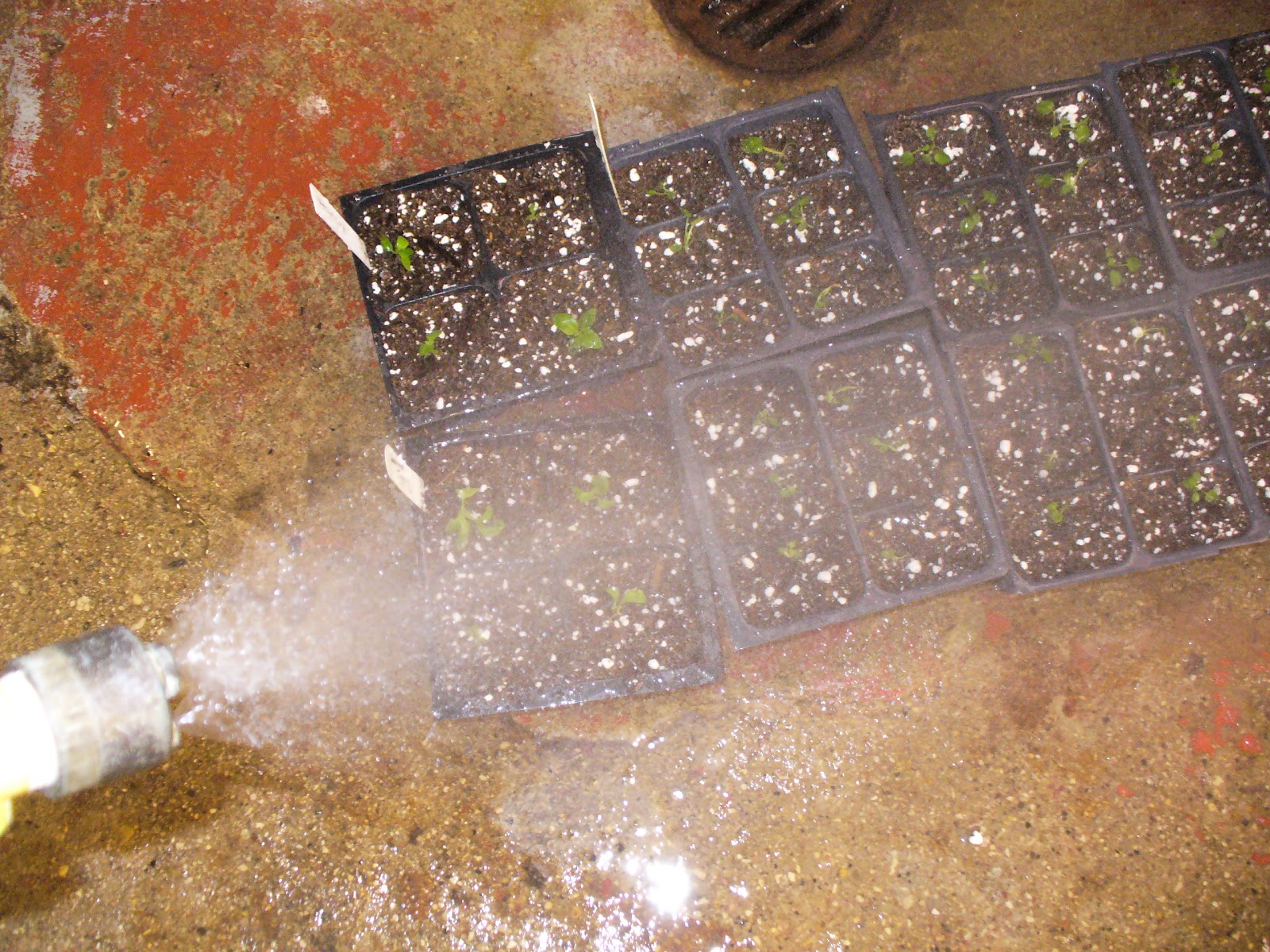
Misting in the seedlings

Transplanting coleus to larger containers


If you find a good misting head for your hose, it is a good investment for watering your new transplants.  They stand up to the watering better and are less likely to be washed out until they can put on enough growth to stand up to the regular watering heads.


Some things I have learned this spring...

  • Wash all your pots and flats before winter.  It is so much easier to do this job outside than it is in the basement and it keeps the extra dirt outdoors and out of your drains.  I am finding out the hard way that I should have done this.  I have been using bleach and also some leftover pool sanitizers for this job.  Follow label recommendations for use.
  • Make a seeding chart, even if it is simple.  I have done a much better job of keeping on task with seeding and transplanting because I had a schedule in my kitchen as a reminder.
  • Think about numbers.  You may get 100 seeds in a pack, but if you only want 12 plants, seed only about twice that.  You will go through a lot less guilt over throwing out the ones you really don't need or cannot pass on to someone else.
  • Save money on containers in several ways.  Buy containers at the end of the season when they are discounted.  I have saved many pots through the years.  I can't imagine how much I would have spent if I had to go out and purchase everything new.  Even cell packs can stand up to a few seasons of use if you treat them gently enough and clean them up for reuse.  Check with local greenhouses and nurseries if they have containers they are going to dispose of that you may be able to get for free.  Check the curbs in June.  Many people set this stuff out next to their trash in hopes that someone will come along and take it for reuse. 
  • Salvage items from the curb for trellising your garden plants.  You never know what you will find for free.  Check out my pieces of orange snow fence that are going to trellis my garden peas.  I also have some curly willow stuck in the rows of sweet peas to add some interest and support.


Monday, April 9, 2012

Get busy seeding

Motivation finally struck and I got busy seeding today.  Furlough days from work can be good for something.  When I have several items to seed, I will do them all in a single tray.  Start off with a tray filled half way with sterile potting soil.  Add about 1/2" of seed starting mix which is a light weight mix usually with a higher volume of vermiculite.  Avoid breathing vermiculite in as it is not good for your lungs. Level the mix and water down the tray so the water soaks to the bottom.  For each row of seeds I will cut a line as deep as recommended with a seed tag.
There are several options for dispensing the seed.  I have a small plastic seeder which has various size openings depending on the seed.  I like this one for outdoors so the seed does not blow around.  In the house a small wax envelope that some seeds are packaged in is still my favorite tool.
I fold the envelope to create a channel down the lower edge.  Pinch the upper edge between the thumb and middle finger and gently tap with the index finger to nudge the seed gently out the end.  It takes some practice but works well once you get the hang of it.
Cut deeper rows for larger seed and space out so the seedlings will be easily extracted from their neighbor as they grow.
Mark each row as you go.  Put like things together (i.e. petunias, impatiens, tomatoes, etc.) as they usually geminate at similar rates.  Allow at least 1 1/2-2" between different varieties so if one is ready to transplant before the others, you will not disturb the smaller plants while extracting your transplants.
Cover with additional seeding mix lightly as you have already provided the depth with your furrows.  Mist in the plants lightly and place on a warming mat or in a location that will not go through extreme temperature changes.  Setting it in a bay window which has curtains or blinds closed from the room overnight will probably get too chilly for many seeds trying to germinate.  Use a thermometer and look at the seed packets to determine the proper temperature range.  Some seeds prefer light while others prefer dark germination.  This information is also provided on your seed packet as well as days to sprout.
I have some domed lids that I will use to keep warmth and humidity up in my germination trays.  I will off-set the cover during the day as sunlight tends to make it too warm inside this dome.  Keep trays misted as they start to dry.  Too wet is just as bad as too dry.  One will rot your germinating seeds while the other will kill them as they try to root and sprout with too little moisture.
For some plants that do not like to be transplanted as much (today it was my Thunbergia seeds) I will use small, individual cell packs to start them.  First I fill them to the top with sterile potting mix. Then I depress the seed to the proper depth and cover with seed starting mix.  I used the additional cells to start some lettuce, raddichio and other cold crops which I will transplant out to the garden when they are started.  Water the cells well and check daily for drying, misting as needed until the plants germinate and send up their first set of leaves or cotyledons.  The second set to form will be the true leaves.  Most plants will be ready to transplant after they have one or two sets of true leaves.  I will cover transplanting when my own plants are ready to go.  Have fun seeding.