Showing posts with label transplanting. Show all posts

Sunday, May 11, 2014

Another grafting session


I spent some quality time with my new grafting knife.  After I took my grafting class in Mike Yanny's Nursery School last month, I took some scion cuttings from my neighbor's Golden Delicious tree.  I wrapped them with moist tissue and bagged them in the frig to hold until the time was right for outdoor grafting.  Mike had explained to us that it takes a week of temperatures in the 60's to get a good graft.  The tree or shrub has to have expanding leaves on it (growth has been initiated for the season) as well.  This week provided the temperatures that popped my espalier apple tree this past week.  Saturday morning I went out with the necessary tools and supplies and made my grafts.  I had taken four cuttings, three went on to my Goldencrisp apple which I am trying to turn into an espalier.  The fourth I grafted to my Snowdrift crabapple as an experiement in ornamental to fruiting apple tree.
Besides my new grafting knife, I also had my Felco pruner, grafting paint, masking tape, and an old toothbrush.  I made my cuts like Mike taught us and fixed three grafts at an upper level of my espalier.  Hopefully, two will take on opposites sides to make my life easier.  The grafts are held in place by pressure and tape.  The grafting paint covers the whole scion and I found that the tooth brush worked well for applying it and was disposable besides.  Time will tell now.
In addition to my grafting, I transplanted a bunch of seedlings to trays indoors, seeded a few more things, and set things to order in the yard.  The lawn furniture came out and the snow blowers were drained and put away.  By the end of the day I was tired but pretty happy about what got done.  
Time is running short on seeding indoors.  I will just do my cukes and squash from this point now.  I soaked my sweet peas for my flower trellises so those have to go in today.  The Thunbergia will also have to be transplanted for indoor sprouting.  It is a little late for those, but I will just have to wait a little longer for their bloom.  I guess I better get out and drop those sweet peas in the soil before the day gets away from me.  Happy Mother's Day to the rest of you mothers out there.

Sunday, May 4, 2014

Fitting in the spring tasks, a photo tour

My basement greenhouse is full with overflow to the kitchen window and south facing upstairs window.  I have many transplants to fit soon, so I have to come up with a plan for all the large pots occupying space here.

I have been cleaning out the gardens so I start with a clear base to start this spring.  This is my herb garden with several perennial herbs and reseeding herbs.  I added additional cilantro seed in a larger plot than normal for an early spring harvest.

My potted stock from my grafting class is coming along.  It has been super exciting to see that the grafts are taking and sprouting.  I am keeping my fingers crossed for great success.  I do have the small greenhouse set up this year.  It is a low tech design, but with my husband home during the day he can vent the front for me!

Tomatoes, peppers, and many flowers are close to getting true leaves which means I have lots of transplanting ahead.  I have cabbages and baby pak choi rooting for transplant into the garden.  I think I will have to toss them to the wolves in the outdoor greenhouse soon to make space.

Potted fruiting bushes are a direction I have started to move in last spring.  I have honey berries which have overwintered and are sprouting.  I will be able to take these with me if we have to make a move.  I can't say the same for the peach tree, apple, or kiwi.

I got small variety blueberries from Jung's this spring.  I potted them up to straight peat moss yesterday.  It is my plan to keep them as potted stock so they can go wherever I need them.

Two out of three raised beds are planted.  I have carrots germinating under the cloth (it helps to keep the bed moist) as well as lettuce seeds.  I also have several varieties of kale this year, half a bed of storing onions, a row of bunching onions and radishes.  Some radicchio overwintered, my new crop I am growing as a fall crop this year.  The garlic is also up 6 " already.  Peas were also put in last week but no sprouts as of this morning. 

Thursday, May 16, 2013

The flowering kale saga continues

Last fall I had the most amazing flowering/ornamental kale in my garden.  I had grown the rose flowering for a couple years and love the way it looks in a pot.  At Christmas I add greens and lights and it is even more stunning.  Kale, both ornamental and edible, is an extremely cold tolerant crop.  You really have to add some of this to the garden just because it is still looking beautiful when the temps fall below freezing.
I bought additional flowering kale seed to plant more of the peacock red that was in my front garden last fall.  I only had four plants, but they were show stoppers.  I wanted more.  I picked up another more generic variety when a second choice I ordered was out of stock when my seeds came.  Then I lost track of them.  They didn't make it on my seeding list, and they weren't in my seed box.  This "change of life" has not been always kind to my brain.  I looked everywhere logical and then the illogical.  No seeds. 
I broke down and bought plants.  Millager's  Garden Center had several varieties of 3" plants in a 6 pack tray.  I bought three kinds.  Then I went to my favorite little local garden center Luxembourg Gardens and found three more varieties in the smaller 4 pack which made them really affordable.  Lots of kale for this fall.
Two days later, I am putting away some condiments in the refrigerator and a little, plastic bag falls forward.  Yep, it was the kale seeds.  Since the seeds I have are all different than the plants I bought, I put them all in trays to germinate.  They are germinating well.  If all my chickens hatch, there will be a huge flowering kale display on the dead end this fall.
Now, I don't want to put it all in the garden all summer, so my plan is to pot some of it up and hold it for the summer.  I will fill in the empty holes of fall with the pots.  I started the up-grading process tonight to reduce the water requirements on the pot bound plants I bought. It may all seem a little crazy, but it will be worth it in the end.


Sunday, April 14, 2013

Spring will come...eventually

Yesterday was hours of basement gardening.  After seeding tomatoes and my earliest flowers, I transplanted.  Petunias and violas had set on sometimes two or three sets of true leaves.  Peppers are not far behind.  The coleus that I had cut was rooted enough to put into potting mix. 

To make room for all the new transplants, I refilled the rooting jars with the rest of the coleus cuttings I allowed to grow on the plants the last time.  The remainder of the coleus stock plants are now compost.  I boosted these shorter plants up towards the light with buckets underneath the flats to optimize the artificial light being received by the leaves of the new transplants.

I am an early riser.  This morning was no exception.  After getting the ingredients for fresh bread in the machine, I settled in with a borrowed copy of the book The Worst Hard Time.  I'm enjoying this lesson on the Dust Bowl of the 1930's and how it impacted lives and the environment.  PBS did a similar two part documentary if you are not into reading.  Both are worth the time spent.

I got up from reading to refill my coffee cup.  The scene out my window changed in 30 minutes.  This is Wisconsin.  What was a gray and cold morning is now a white and cold morning.  The peas that I put in the ground are suffering through the indignation.  I did put a clear plastic tunnel over the row (concerned about excessive rain rotting the seed).  I really am not sure how the peas seeds will handle this.  Only time will tell.  Gambling the old seed to the soil is worth the chance.  There are more pea seeds at the garden center.

Sometimes, as a gardener, you have to make your best guess about what the weather will do.  I gambled on the peas, but left the beet, radishes, and other root vegetable seeds on my kitchen counter waiting for a better day.  Looking out the window, it seems that spring will never come.  It will in its own time.  I will continue to enjoy my book while I wait.

Saturday, May 5, 2012

Eviction Notice

The larger, hardy plants have gotten their eviction notice.  Such a cruel thing to do on a cool, rainy morning.  But, it had to be done.  My jasmine, scented geranium trees, mandevilla vine and rosemary all got moved to the north side of the garage to start the acclimation process.  They are just steps away from the service door, so should cold weather strike, I move them in there to take cover.
I moved a few of the potted items outdoors as well this morning.  My ivy geraniums and citronella geraniums were put into larger pots and put on the rolling rack.  The alpine strawberry boxes are added weight to the shelves for now, but will find a home hanging on the fence or someplace else soon.  I added casters to this shelf last fall.  Now I will be able to roll it into the garage on cold nights instead of moving the flats in one by one to the floor of the garage.  Next week will result in more evictions as I need the space indoors.
The reason for the evictions was two fold.  First, the larger plants need to acclimate.  Second, I ran out of room and transplanting had to be done.  My tomatoes have a good set of second leaves with strong centers.  I upgraded my Black-eyed Susan vines (Thunbergia). I flatted up the rooted coleus.  Also completed transplanting of tomatoes, agastache, some petunias, and parsley.  I came up with a solution for getting the new transplants within 6" of the lights.  I turned over 4, 4" pots at the corners of the flats to give them a boost up towards the lights.
I had great germination of the Thunbergia which are starting to vine.  For Christmas, my sister gave each of us a Topsy-Turvy strawberry planter.  I was not going to use it for strawberries so that became my transplanting vessel for some of the vines.  The variety I bought this year is Spanish Eyes, which is slightly lighter than the traditional Black-eyed Susan vines I have had, which I grew from saved seed with a 25% germination rate.  Some of these will go along the fence to vine in with the sweet peas, which will fade during the warm weather.  I also had some with the Sweet Autumn clematis last year.  The yellow and white combination was beautiful last fall.  
I have to balance the check book now so I can get over to the garden center today for more potting soil.  I am sticking with a light-weight mix which has served me well for indoor use.  I will also get some for the pots which will be coming together soon.  This winter I purchased an organic blend which was intended for indoor use.  I was skeptical of the heavier weight it had and it seemed to have "something" weird about it.  White flies showed up soon after (which I never had in my house before).  Another minus of this blend was that all the seed I started with this as my base layer had extremely poor germination.  Hard lessons are learned when I try to move forward against my better judgement.  Maybe I will listen to myself next time.  I really need to get a move on as time is running short in the day.  The garden center will not be a quick trip as I will want to browse.  Enjoy your own weekend.  Now that spring is really here, take time to stop and smell the flowers.
Jasmine

Monday, April 23, 2012

So, what's up?

I kept myself pretty busy with gardening this week.  So much is happening inside and outside the house now.  I will do a quick run-down on the seeds I have gotten in and what has sprouted so far.


Seeding


On 4/9 I seeded agastache, hollyhocks, petunias, impatiens, thunbergia, radicchio, and lettuce.  The hollyhock were up on 4/12, petunias on 4/14, radicchio 4/12, and thunbergia on 4/18.  The impatiens have also started sprouting but very spotty.  That does not make me happy.
On 4/7 I seeded some of the garden seeds. Flowering sweet peas and garden peas were both soaked 24 hours and then into the ground.  The garden peas are up as of 4/18, nothing with the flowering sweet peas yet.  I seeded more outdoors on 4/12, green onions, beets, Swiss chard, radishes.  The radishes were up by 4/18.
On 4/15 I seeded tomatoes, peppers, marigolds, asters, zinnia and nasturtiums. Tomatoes, marigolds, asters and zinnias were all up on 4/18.  
I have one more round of seeding this next week for indoor plants.  I will get the soybeans in the ground this next week along with some of the direct seeding of flowers.  I put the first round of cilantro seeds in the ground over the weekend.  Let's see if I remember to get a few seeds in every couple weeks this year.


Transplanting


This weekend I was able to transplant the earliest seeding from mid-March.  I started them before going on vacation and they had less than ideal germination without someone checking on them twice a day.  I do not hold this against my eldest as she did bring some of them through for me.  The viola germinated the best, and I was able to transplant 36 good seedlings.  Heliotrope came through with 6 plants.  We won't talk about the mammoth stock which are not living up to their name.  I also moved my coleus into larger pots so they can put on a little more growth before May garden time.
Transplanting viola seedlings

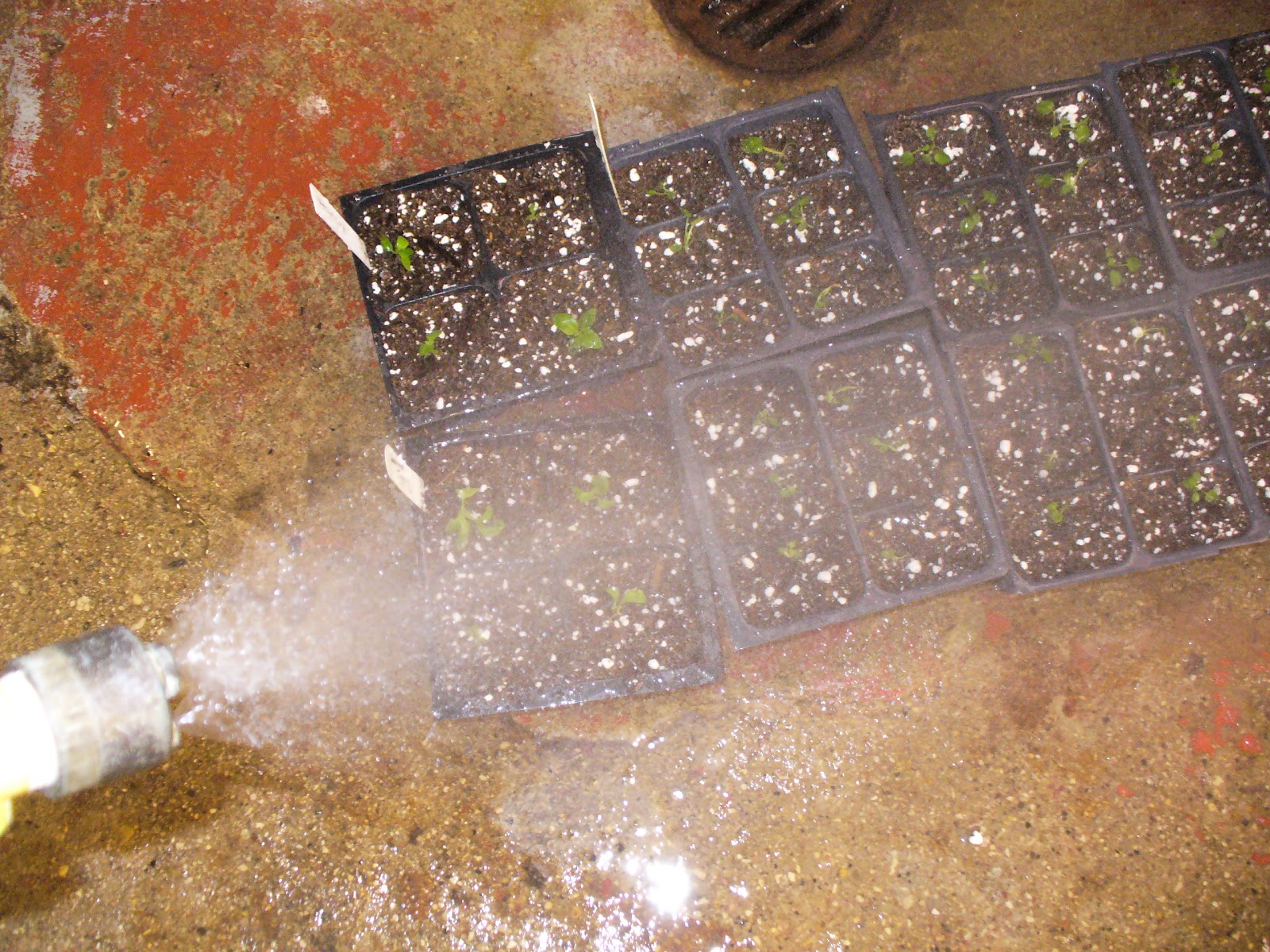
Misting in the seedlings

Transplanting coleus to larger containers


If you find a good misting head for your hose, it is a good investment for watering your new transplants.  They stand up to the watering better and are less likely to be washed out until they can put on enough growth to stand up to the regular watering heads.


Some things I have learned this spring...

  • Wash all your pots and flats before winter.  It is so much easier to do this job outside than it is in the basement and it keeps the extra dirt outdoors and out of your drains.  I am finding out the hard way that I should have done this.  I have been using bleach and also some leftover pool sanitizers for this job.  Follow label recommendations for use.
  • Make a seeding chart, even if it is simple.  I have done a much better job of keeping on task with seeding and transplanting because I had a schedule in my kitchen as a reminder.
  • Think about numbers.  You may get 100 seeds in a pack, but if you only want 12 plants, seed only about twice that.  You will go through a lot less guilt over throwing out the ones you really don't need or cannot pass on to someone else.
  • Save money on containers in several ways.  Buy containers at the end of the season when they are discounted.  I have saved many pots through the years.  I can't imagine how much I would have spent if I had to go out and purchase everything new.  Even cell packs can stand up to a few seasons of use if you treat them gently enough and clean them up for reuse.  Check with local greenhouses and nurseries if they have containers they are going to dispose of that you may be able to get for free.  Check the curbs in June.  Many people set this stuff out next to their trash in hopes that someone will come along and take it for reuse. 
  • Salvage items from the curb for trellising your garden plants.  You never know what you will find for free.  Check out my pieces of orange snow fence that are going to trellis my garden peas.  I also have some curly willow stuck in the rows of sweet peas to add some interest and support.


Monday, April 9, 2012

Get busy seeding

Motivation finally struck and I got busy seeding today.  Furlough days from work can be good for something.  When I have several items to seed, I will do them all in a single tray.  Start off with a tray filled half way with sterile potting soil.  Add about 1/2" of seed starting mix which is a light weight mix usually with a higher volume of vermiculite.  Avoid breathing vermiculite in as it is not good for your lungs. Level the mix and water down the tray so the water soaks to the bottom.  For each row of seeds I will cut a line as deep as recommended with a seed tag.
There are several options for dispensing the seed.  I have a small plastic seeder which has various size openings depending on the seed.  I like this one for outdoors so the seed does not blow around.  In the house a small wax envelope that some seeds are packaged in is still my favorite tool.
I fold the envelope to create a channel down the lower edge.  Pinch the upper edge between the thumb and middle finger and gently tap with the index finger to nudge the seed gently out the end.  It takes some practice but works well once you get the hang of it.
Cut deeper rows for larger seed and space out so the seedlings will be easily extracted from their neighbor as they grow.
Mark each row as you go.  Put like things together (i.e. petunias, impatiens, tomatoes, etc.) as they usually geminate at similar rates.  Allow at least 1 1/2-2" between different varieties so if one is ready to transplant before the others, you will not disturb the smaller plants while extracting your transplants.
Cover with additional seeding mix lightly as you have already provided the depth with your furrows.  Mist in the plants lightly and place on a warming mat or in a location that will not go through extreme temperature changes.  Setting it in a bay window which has curtains or blinds closed from the room overnight will probably get too chilly for many seeds trying to germinate.  Use a thermometer and look at the seed packets to determine the proper temperature range.  Some seeds prefer light while others prefer dark germination.  This information is also provided on your seed packet as well as days to sprout.
I have some domed lids that I will use to keep warmth and humidity up in my germination trays.  I will off-set the cover during the day as sunlight tends to make it too warm inside this dome.  Keep trays misted as they start to dry.  Too wet is just as bad as too dry.  One will rot your germinating seeds while the other will kill them as they try to root and sprout with too little moisture.
For some plants that do not like to be transplanted as much (today it was my Thunbergia seeds) I will use small, individual cell packs to start them.  First I fill them to the top with sterile potting mix. Then I depress the seed to the proper depth and cover with seed starting mix.  I used the additional cells to start some lettuce, raddichio and other cold crops which I will transplant out to the garden when they are started.  Water the cells well and check daily for drying, misting as needed until the plants germinate and send up their first set of leaves or cotyledons.  The second set to form will be the true leaves.  Most plants will be ready to transplant after they have one or two sets of true leaves.  I will cover transplanting when my own plants are ready to go.  Have fun seeding.

Monday, March 12, 2012

Gardens inside, gardens outside...what a crazy spring!

I have started the early seeds of Heliotrope, Mammoth Stocks, and Violas.  They are in the dome to keep the temperature and moisture higher with my seed heating mat underneath.  The dome is ventilated to keep temperatures moderate. 
Onions are up and almost ready for their first hair cut.  When they reach 6" cut them back to 3".  When you are two weeks out from transplanting (April 15th is my date, weather and soil dependent) start setting them outside for a few hours a day, lengthening that time each day.

My first crop of basil and cilantro have been transplanted to cell packs.  I will keep these under lights and harvest the leaves as an indoor crop.  If the basil holds up well, I will move it outdoors.  My plan otherwise is to start more basil seedlings May 1st and direct sow more cilantro into the herb garden.  Cilantro is a crop worth seeding a little bit every two or three weeks to keep it coming all season long.

Coleus, rosemary, and ibosa are all rooting in my jars along my kitchen window sill.  This is also where I am keeping my seedlings and small starts so I can keep a good eye on them.

I have been dividing and upgrading my plants as they have showed signs that they are crowded in their pots.  It is becoming painfully obvious that I really need to come up with an outdoor structure to hold my abundance of plants.

I took a good hour of my weekend to sterilize and wash pots and flats.  I think this is something I am going to try and do in the fall when I can take it all out to the driveway and garage where I have more room to set everything out to dry.  I also will be ready to transplant at a moment's notice so maybe I will not procrastinate so much.
How exciting to come home from work on March 12th and see my dwarf irises in bloom.

The first snowdrops are nodding their heads in approval of our very warm, Spring weather.

Tulips and daffodils are up almost 6" now.  I plant my tulips in the middle of daffs to keep the rabbits from biting off their heads.  It really works.

Rhubarb is showing color and pushing out of the dirt.

I will have early parsley from these plants.  Parsley is biennial so it will set flowers and seeds this year.  I will start new plants to take their place when the time comes.

Garlic is up and making a good showing.  This is one of the fall planted bulbs.  Separate the cloves and plant each individual clove 6" apart and 3-4" deep in mid-fall.  If your soil is tillable you may get some in with our early spring.

Spring is busting out all over!

Monday, March 5, 2012

Seeding Schedule

Seed Starting Schedule 2012
Date                              Indoor Seeding                             Outdoor Seeding


March 1-15
Heliotrope Marine
Viola ‘Bowles Black’
Stock Mammoth excelsior


April 7
                                      Agastache                                                     Green onion
                                                Hollyhocks                                                    Transplant onion seedlings
                                                Petunias (3 varieties)                                  Beets
                                                Impatiens (2)                                                 Spinich
                                                Thunbergia (2)                                             Kale
                                                Lettuce                                                           Swiss Chard
                                                Parsley


April 14-28
                                      Tomatoes (4)                                                 Sweet peas (flowering)
                                                Peppers (3)                                                   Garden peas
                                                Marigolds (2)                                                 Coriander/Cilantro
                                                Asters (2)                                                       Dill
                                                Zinnias (2)                                                     Soybeans
                                                Nasturtiums                                                  Radishes


April 28- May 5
                                                Flowering kale (2)                                        Bachelor buttons
                                                Tithonia (2)                                                    Poppys
                                                Lettuce                                                           Evening Scented Stock
                                                Basil                                                               Allysum
                                                Zucchinni                                                      Cosmos
                                                Cucumbers
                                                Raddicchio                                                   


May 26-28                                                                             
                                                Transplant flowers                                       Beans-pole and bush        
                                                                                                                        Cilantro


June 2-3                                                                                Transplant tomatoes/peppers
                                                                                                                        

I finally sat down this weekend with my seeds and planned out when I will need to get things done this spring.  With all I chose to take on I had to make some decisions on what was going to get an early start in the house and what would have to wait for warmer temperatures outside.  I would like to get my cold frame together this year and I have always had a design in mind for a small greenhouse for the south side of my house.  This might be the year I get at least one of those things done.  I do have a 3 tiered shelf on wheels which can be rolled into and out of the garage, so that is a good start.  I can thank this blog for giving me the extra boost to get some of these things done.  Once you put something down in writing, it is extra incentive to get the project done.  This is also the first year I have written a seeding schedule out instead of relying on my memory to get things done.  I hope it also helps provide a basic template for those of you who are looking to do the same.